
The Legend of Big Major Cay and Its Porcine Settlers
If you spend enough years steering a boat through the turquoise cuts of the Exuma Cays, you learn that every island has a story etched into its limestone. My parrot, Sloop, usually perches on the console while I calculate tides between Staniel Cay and Big Major Cay, and I reckon he has heard me explain this tale a thousand times. Visitors step onto the deck of my vessel expecting a simple tourist spot, but where these swine originally come from is something every boater asks about. The herd of twenty to twenty-five feral pigs living on this uninhabited cay did not fall from the sky, nor did they evolve on white sand beaches. Understanding their journey requires looking past the glossy photographs and reading the historical tides of our Bahamian waters.
Separating Maritime Folklore from Shoreline Fact
For decades, passing sailors and charter guests traded colorful stories over dark rum at docksides. The most romantic legend claims that 17th-century pirates or Spanish privateers dropped a drift of pigs on Big Major Cay as living rations. According to that tall tale, the mariners planned to return later, drop anchor, and harvest fresh pork, but their ships were lost in storm currents or naval battles, leaving the stock behind. Another widely repeated myth involves a catastrophic shipwreck offshore, where a vessel shattered against shallow reef heads and the livestock on board swam through heavy ocean swell to reach the nearest shoreline.
Every captain who drops anchor near Big Major Cay has heard a dozen tall tales about how these pigs arrived. But if you read the tides and talk to the elders on Staniel Cay, you get the actual truth behind the swine.
The Real Agricultural Roots: Relocation from Staniel Cay
The true story is grounded in practical Bahamian farming rather than high-seas privateering. During the early 1990s, residents living on nearby Staniel Cay kept livestock to feed their families. As the village expanded, smell and hygiene concerns arose regarding keeping farm animals close to homes. Local farmers, including Wayde Nixon and Henry Nixon, decided to relocate their herd across the narrow channel to Big Major Cay, an uninhabited island with natural brush and freshwater pockets. Around the same period, regional anxieties surrounding the Persian Gulf War prompted islanders to secure a sustainable local food supply in case supply ships from the mainland faced disruption.
The farmers built pens on the cay to manage the herd, visiting regularly by wooden motorboat to bring vegetable scraps, leftover food, and grain. Teh animals quickly learned the sound of approaching outboard motors, associating boat engines with fresh food arriving on the beach. Over time, the pigs broke out of their enclosures and spread across the island scrub, adopting feral habits while remaining dependent on human visits for supplemental sustenance.
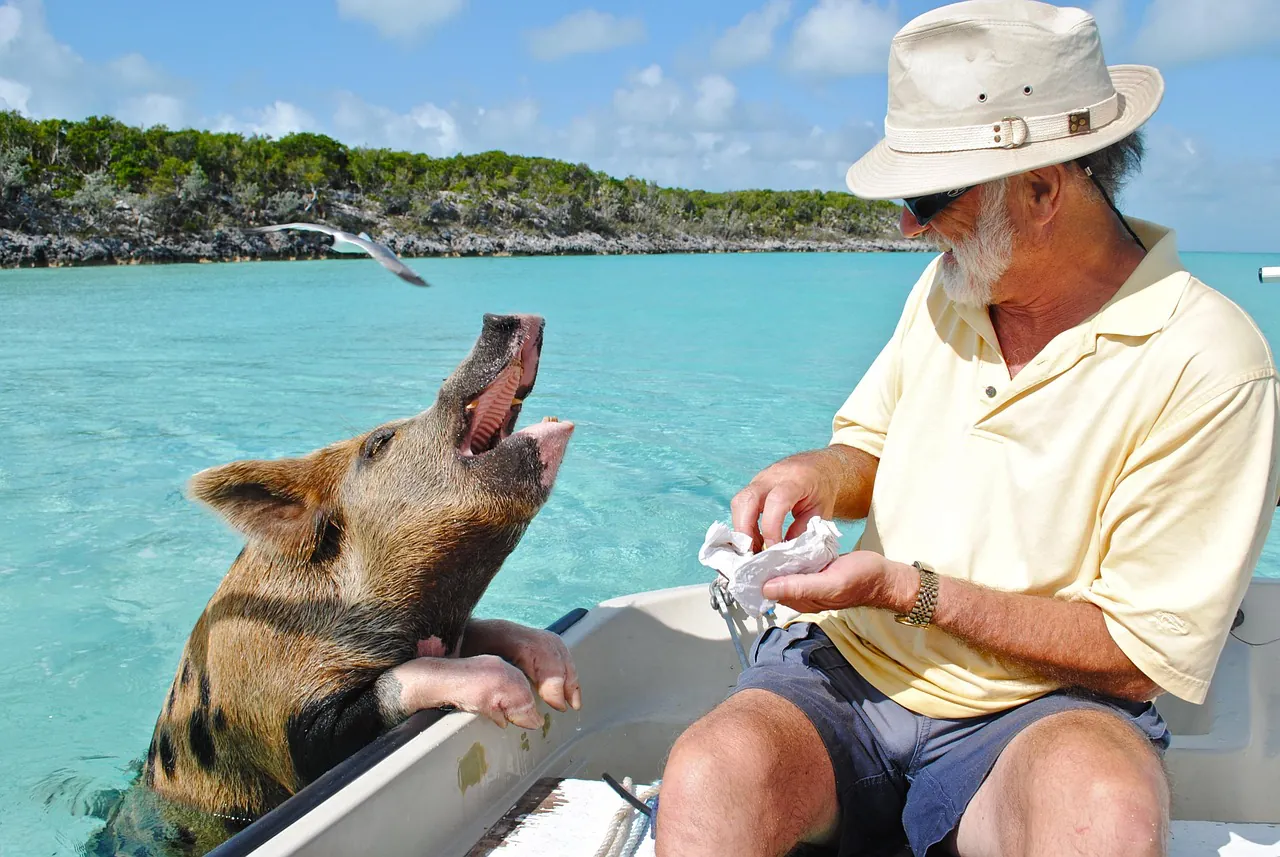
As the herd adapted to life in the Exumas, their behavior shifted dramatically. Instead of waiting patiently on dry ground for farmers to wade ashore with feed buckets, the braver pigs waded into the calm shore break. Eventually, the animals began paddling directly toward anchored yachts, discovering that cruising sailors would toss food over the gunwales. That behavioral leap set the foundation for what eventually became an international travel phenomenon.
Porcine Biology: How Land Mammals Learned to Paddle
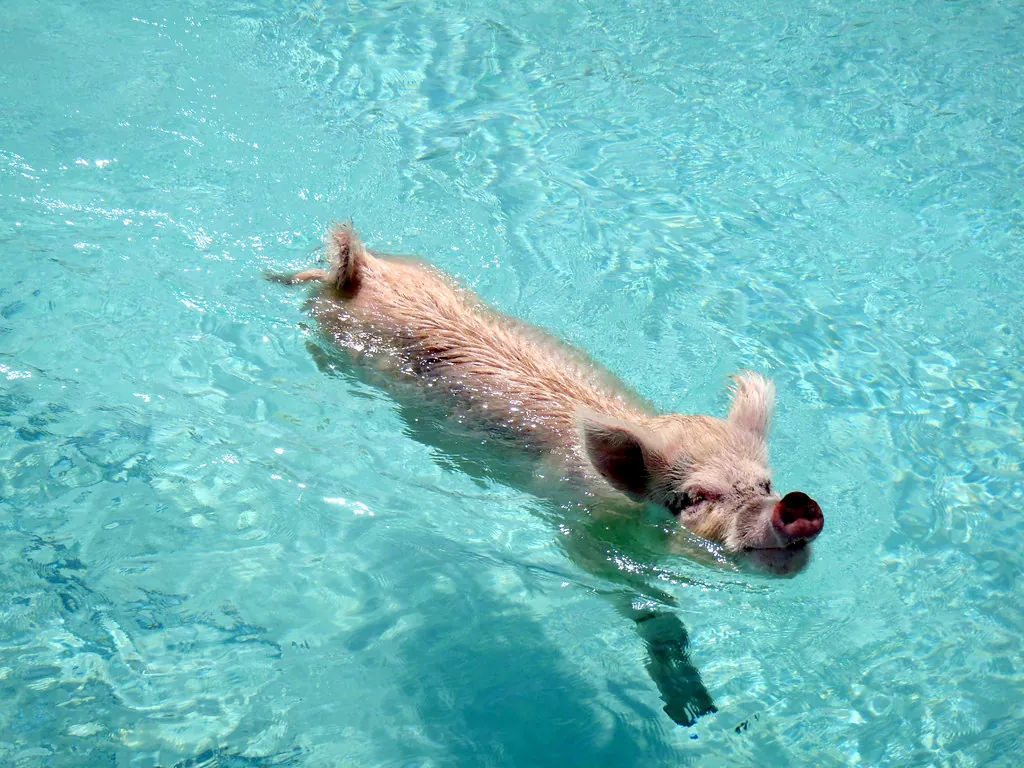
Many travelers express genuine surprise when seeing a two-hundred-pound sow swimming through six feet of crystal water. From a biological standpoint, domestic and feral pigs are natural swimmers with buoyant bodies and strong snout control that keeps their nostrils well clear of the water line. What makes the herd at Big Major Cay unusual is not their physical capability, but their motivation. Driven by tropical heat and the incentive of food, these pigs developed a habit of aquatic foraging that is practically unique to this specific cay. For detailed information on reaching this beach by air or sea, consult our comprehensive transportation guide.
| Historical Era | Popular Theory / Milestone | Documented Historical Reality |
|---|---|---|
| 17th – 18th Century | Pirate Rations Legend | No archival evidence supports pirates leaving livestock on Big Major Cay. |
| Mid-20th Century | Shipwreck Survivors Myth | Local maritime records show no shipwreck event involving livestock in this cut. |
| Early 1990s | Agricultural Relocation | Staniel Cay farmers moved swine across the water to resolve village odor issues. |
| Late 1990s | Cruiser Lore & SCYC | Tales of “Emily the Pig” spread among boaters at the Staniel Cay Yacht Club. |
| 2014 – Present | Documentary & Media Boom | Films like When Pigs Swim and books by T.R. Todd launched worldwide fame. |
From Quiet Cay to Global Fame: The Media Explosion
Word of the swimming swine spread quietly through marine circles during the 1990s. Yacht crews anchored in Big Major spot would share tales at the Staniel Cay Yacht Club bar, referring fondly to an early matriarch known as “Emily the Pig.” The attraction remained a local secret until author T.R. Todd published research detailing the island’s story, alongside director Charlie Smith’s short documentary When Pigs Swim. These projects, followed by Todd’s book Pigs of Paradise, brought global attention to the small Bahamian colony.
The explosion of social media platforms transformed the island overnight. Celebrities, television crews, and travel influencers filmed themselves swimming alongside the herd, projecting images of turquoise water and paddling piglets to millions of screens. Official promotional campaigns by the Bahamas Ministry of Tourism cemented Pig Beach as a anchor icon of Bahamian travel, drawing visitors from every corner of the globe. You can read more about broad island itineraries on our guide to the Exuma island hopping route, or check general details on our Pig Beach homepage.
Protecting the Colony: 2017 Tragedy and Modern Ethical Travel
Global fame brought unintended consequences for the herd. In early 2017, a tragic event occurred when several pigs died suddenly on the beach. Medical examinations revealed that the animals had ingested large amounts of sand while consuming food thrown onto dry ground by tourists, combined with severe dehydration during a spell of dry weather. The loss sparked urgent action among local residents, government officials, and animal welfare advocates to establish proper protections for the herd.
Today, local stewards oversee the colony to ensure its survival. Fresh water troughs sit tucked beneath the tree shade, and regular veterinary visits monitor the health of every piglet and sow. Regulations strictly ban visitors from feeding the pigs processed snacks, alcohol, or throwing food onto the beach sand where it gets coated in grit. To ensure your visit supports the welfare of these animals, review our detailed Visitor Rules & Guidelines and check seasonal weather considerations on our Practical Planning guide before heading out onto the water.